
.png)
Beyond Rituximab: Obinutuzumab Redefines Treatment Resistant Membranous Nephropathy
Updated: May 5
Written by Priyadarshini John, DM
Primary membranous nephropathy (MN) is a prototypical autoimmune glomerular disease and one of the most common causes of nephrotic syndrome in adults. The discovery of circulating autoantibodies against podocyte antigens, most notably the phospholipase A2 receptor (PLA2R) has transformed the understanding of its pathogenesis, firmly establishing MN as a B-cell–mediated disorder. This paradigm shift has led to the emergence of targeted immunotherapies aimed at depleting B cells and interrupting autoantibody production.
Among these, anti CD20 monoclonal antibodies (Table 1) have become central to the management of MN. CD20 is a surface antigen expressed on pre-B and mature B lymphocytes, making it an ideal therapeutic target for modulating humoral immunity. The first-generation anti-CD20 antibody, rituximab, a chimeric type I monoclonal antibody, has demonstrated substantial efficacy in inducing remission in MN and is now widely recommended for patients at moderate to high risk of disease progression. Its mechanism of action primarily involves complement-dependent cytotoxicity and antibody-dependent cellular cytotoxicity, leading to depletion of circulating B cells.
Despite its widespread use, Rituximab is not universally effective. Approximately one-third of patients fail to achieve remission or develop resistance. Several mechanisms have been proposed to explain this phenomenon. These include pharmacokinetic limitations such as urinary loss of the drug in patients with heavy proteinuria, as well as immunogenicity resulting in the formation of anti-rituximab antibodies. At a cellular level, internalization and degradation of the CD20–rituximab complex can reduce drug efficacy, allowing persistence of auto reactive B cells and continued autoantibody production. Furthermore, rituximab may have limited ability to deplete B cells residing in lymphoid tissues, particularly memory B cells that are sustained by B-cell activating factor (BAFF).
To address these limitations, newer generations of anti-CD20 monoclonal antibodies have been developed with enhanced pharmacodynamic properties (Figure 1). These include fully human or humanized antibodies such as ofatumumab and obinutuzumab, which differ in their structure, binding characteristics, and mechanisms of B-cell depletion.

Ofatumumab, a fully human type I anti-CD20 antibody, binds to a distinct epitope on the CD20 molecule with greater affinity and induces more potent complement-dependent cytotoxicity than Rituximab. It has been explored as an alternative in patients intolerant or resistant to rituximab, although clinical experience in MN remains relatively limited.
Obinutuzumab represents a further evolution in anti-CD20 therapy. It is a Glycoengineered, humanized type II monoclonal antibody designed to overcome key resistance mechanisms associated with earlier agents. Unlike type I antibodies such as rituximab and ofatumumab, obinutuzumab binds to CD20 in a different orientation and over a larger epitope, which prevents internalization of the CD20–antibody complex, a major contributor to rituximab resistance. Additionally, glycoengineering of its Fc region enhances its affinity for FcγRIIIa receptors on immune effector cells, resulting in markedly increased antibody-dependent cellular cytotoxicity.
Importantly, Obinutuzumab induces direct, non-apoptotic B-cell death through lysosomal pathways, a mechanism that is largely independent of complement activation. This is particularly relevant in the context of MN, where complement-independent pathways may be advantageous in achieving deeper and more sustained B-cell depletion. Furthermore, Obinutuzumab has demonstrated superior efficacy in depleting B cells within secondary lymphoid organs, including memory B-cell populations that are often resistant to rituximab due to BAFF-mediated survival signals.
Another advantage of Obinutuzumab is its humanized structure, which reduces the likelihood of anti-drug antibody formation and minimizes immunogenicity. This makes it especially suitable in patients who have developed hypersensitivity or neutralizing antibodies to rituximab after repeated exposure.
Collectively, these mechanistic advantages suggest that Obinutuzumab may achieve a more profound and durable immunological response compared with earlier anti-CD20 therapies. In diseases such as MN, where sustained suppression of autoreactive B-cell clones is essential for long-term remission, such properties could translate into improved clinical outcomes, particularly in patients with refractory disease.

Table 1: Core mechanistic differences between various anti CD 20 antibodies
There have been several small studies showing the efficacy of Obinutuzumab in high risk patients. Lin et al reported one of the largest retrospective cohorts of obinutuzumab in membranous nephropathy, including 18 patients with mixed disease profiles (Rituximab-resistant, relapsing, and treatment-naïve). The study demonstrated a high overall remission rate of approximately 94%, with significant reductions in proteinuria and anti-PLA2R antibodies, supporting the efficacy of Obinutuzumab in a heterogeneous population. A small Australian series involving five patients with predominantly PLA2R-positive, Rituximab-resistant disease showed high response rates, including complete remission. In KI Reports Research Letter, Sethi et al described a small case series in including patients with both native and transplant-associated membranous nephropathy. The study demonstrated favourable clinical and immunological responses to obinutuzumab, highlighting its potential role in difficult-to-treat settings such as post-transplant recurrence.
Despite this strong biological rationale, clinical data on Obinutuzumab in primary MN have been limited. The present study was therefore designed prospectively to evaluate its efficacy and safety in patients with rituximab resistant or intolerant disease, a population with few effective therapeutic options and a high risk of progression. By integrating clinical outcomes with detailed immunological assessments, this study aims to provide a more comprehensive understanding of the role of next-generation anti-CD20 therapies in redefining the treatment landscape of membranous nephropathy.
Study Design and Patient Population
This was a prospective, single centre, open-label cohort study involving 20 adult patients with biopsy-proven primary membranous nephropathy and persistent nephrotic syndrome despite prior Rituximab therapy.
All patients had significant disease burden at baseline, characterised by nephrotic-range proteinuria, hypoalbuminemia, and varying degrees of kidney dysfunction. Importantly, none had achieved remission following their most recent Rituximab treatment, confirming true treatment resistance. Many had also been exposed to other immunosuppressive therapies, underscoring the refractory nature of the cohort.
Obinutuzumab was administered as a fixed-dose regimen consisting of three intravenous infusions of 1000 mg each, given over a period of four weeks. The first dose was delivered as a split infusion, with 100 mg administered on day 1 followed by the remaining 900 mg on day 2, in order to improve tolerability and reduce infusion-related reactions. Subsequent doses of 1000 mg each were administered at week 2 and week 4. Thus, the total cumulative dose of Obinutuzumab was 3000 mg, delivered within one month. All patients received standard premedication with paracetamol, antihistamine, and intravenous corticosteroids prior to each infusion.
Patients were followed longitudinally for clinical, biochemical, and immunological outcomes over 12 months, with extended follow-up to 24 months in a subset.
Efficacy Outcomes
The study demonstrated a remarkably high response rate in a population traditionally considered resistant to treatment. At 12 months, 16 out of 20 patients (80%) achieved remission, including both complete and partial responses. Four patients achieved complete remission, while others had significant partial remission. Overall, 17 patients (85%) reached remission during follow-up. Figure 1.
Figure 1. Kaplan–Meier curve for complete or partial remission.

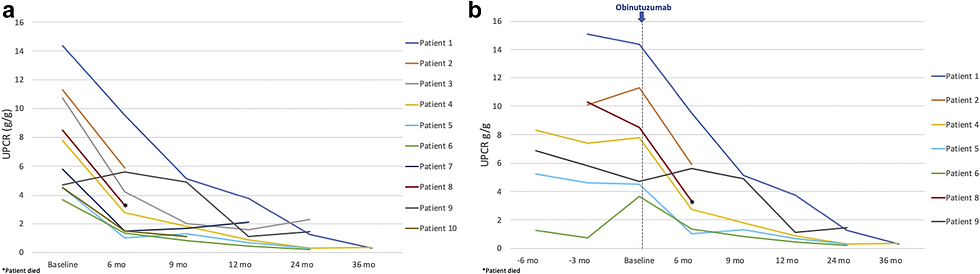
A key clinical finding was the substantial reduction in proteinuria, which declined from a median of approximately 5.7 g/day at baseline to 1.3 g/day at 12 months. This reduction was progressive and sustained, with many patients crossing below the nephrotic threshold by 6 months. Simultaneously, serum albumin levels improved significantly, reflecting restoration of oncotic balance and improvement in nephrotic state. Importantly, no patients experienced relapses after achieving remission during the follow-up period, highlighting the durability of the response. Figure 2.
Figure 2. (a) Urine protein-to-creatinine ratio (UPCR) trend after obinutuzumab in all patients. (b) UPCR trend before and after obinutuzumab in rituximab-experienced patients.
Renal Function and Systemic Effects
Despite significant immunological and clinical changes, glomerular filtration rate (GFR) remained stable, indicating that treatment prevented further renal decline. The therapy also resulted in broader systemic benefits like significant reduction in dyslipidemia, particularly total and LDL cholesterol, improvement in hypoalbuminemia and hypoproteinemia and reduction in urinary losses of albumin and IgG, reflecting improved glomerular barrier integrity.
These changes collectively indicate not just disease control but overall amelioration of nephrotic syndrome pathophysiology.
Immunological Findings
Obinutuzumab demonstrated a profound and sustained immunological effect. Obinutuzumab led to rapid and near-complete depletion of B-cells within the first 3–6 months, followed by a gradual reconstitution starting around 9–12 months, with recovery by 24 months. Interestingly, B-cell return did not lead to relapse, and anti-PLA2R antibodies remained suppressed, suggesting a durable immune reset, rather than temporary suppression. At the same time, BAFF levels increased during depletion and decreased with B-cell recovery, reflecting normal immune feedback. Overall, obinutuzumab shows a pattern of deep B-cell depletion followed by stable, relapse free reconstitution, which likely explains its sustained clinical benefit.
Safety and Tolerability
The treatment was generally safe and well tolerated.No opportunistic infections were reported. Only one serious adverse event occurred, which was unrelated to the drug. Minor infusion-related reactions (e.g., rash, chills) were manageable and transient.
Strengths and Limitations of the study
This study is strengthened by its prospective design, enabling systematic data collection and improving the reliability of treatment response assessment. A key highlight is the inclusion of a clearly defined Rituximab-resistant population, making the high remission rates especially notable in a group that would otherwise be expected to have poor outcomes.
The study adopts a comprehensive, multidimensional evaluation, incorporating both clinical parameters (proteinuria, albumin) and immunological markers (anti-PLA2R antibodies, B-cell kinetics). Importantly, the demonstration of sustained immunological remission despite B-cell reconstitution provides valuable mechanistic insight into durable immune modulation. The consistency and durability of response, with no observed relapses and sustained benefit up to 24 months in some patients, further strengthen the findings.
Additionally, the study offers practical real-world insights into the feasibility, safety, and tolerability of Obinutuzumab in a high-risk population.
Limitations
The study is limited by its small sample size (n=20), restricting generalizability and the ability to detect rare outcomes. The single-arm, non randomized design without a control group limits definitive causal inference. Being a single-center study, the findings may be influenced by center-specific practices, affecting external validity. The follow-up duration, while extending to 24 months in some patients, is relatively short for a chronic relapsing disease like membranous nephropathy. The cohort is also demographically homogeneous, limiting applicability across diverse populations. While immunological findings are robust, mechanistic conclusions remain indirect, with no direct evidence of eradication of autoreactive B-cell clones. Finally, the open-label design introduces potential bias, although primary outcomes were largely objective.
Conclusion
In conclusion, Obinutuzumab shows significant promise as a next-generation anti-CD20 therapy in rituximab-resistant membranous nephropathy, offering both high efficacy and durable remission. Larger, randomized studies with longer follow-up are needed to confirm these results and define its optimal role in treatment algorithms.


Comments