
.png)
Stopping ADPKD Progression: What We Know & What We Can Do Now
Written by: Bogdan Agavriloaei MD
Infographic by: Kajaree Giri MD
Autosomal dominant polycystic kidney disease (ADPKD) is the most common genetic renal disorder, with an estimated prevalence between 1:1000 and 1:2500. Genetically, the condition is primarily caused by mutations in two genes: PKD1 (encoding polycystin-1) and PKD2 (encoding polycystin-2). Polycystins are proteins that regulate key cellular processes such as fluid transport, differentiation, proliferation, apoptosis, and cell adhesion.
The management of autosomal dominant polycystic kidney disease is currently divided into two major therapeutic directions. The first consists of supportive therapy, focused on blood pressure control, prevention of complications, and optimization of renal function. The second includes disease-modifying therapy, which aims to alter the natural course of the disease by reducing the rate of kidney volume expansion and slowing the decline in renal function.
Key Mechanisms Driving ADPKD Progression
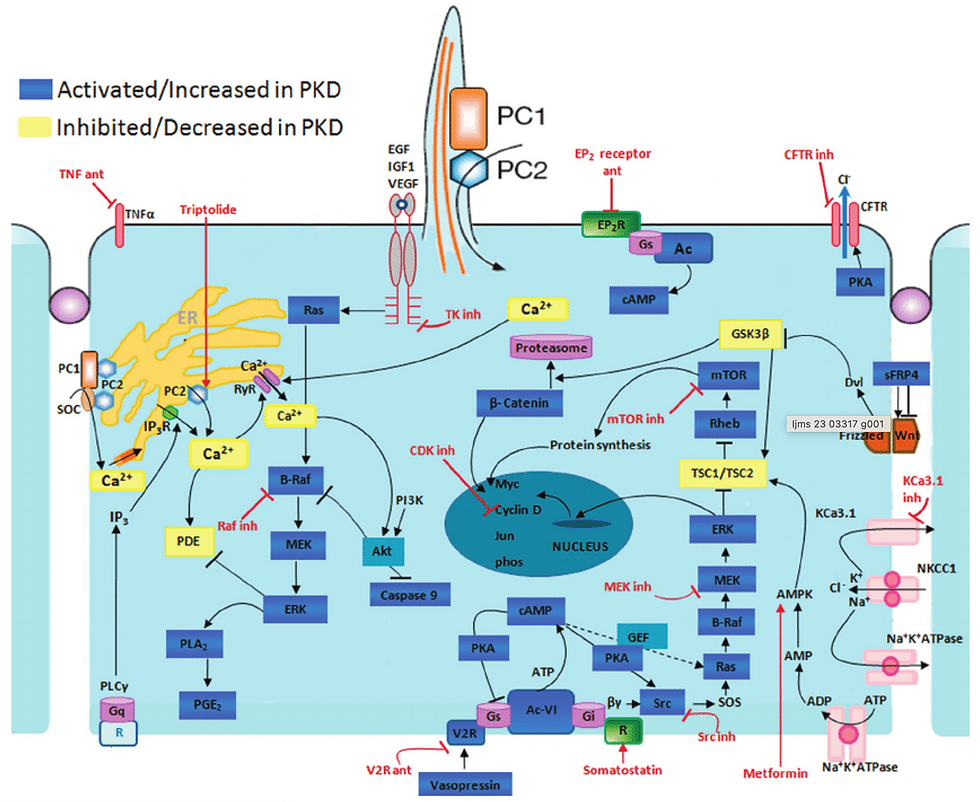
The hallmark manifestation of ADPKD is the progressive development of renal cysts, which arise in approximately 1–3% of all nephrons. The complex formed by polycystin‑1 (PC1) and polycystin‑2 (PC2), first described in 2018, represents the central pathophysiological element responsible for initiating and sustaining cystogenesis. Renal cyst formation involves dysregulation of multiple intracellular signaling pathways, including the ya cyclic AMP pathway, TSC–mTOR, PI3K/Akt, JAK–STAT, the Id pathway, G-protein–dependent signaling, and the Wnt pathway. These alterations converge to promote aberrant tubular cell proliferation and increased fluid secretion, ultimately driving progressive cyst expansion and remodeling of the renal parenchyma. Against this pathophysiological backdrop, controlling modifiable factors of disease progression becomes a priority in the management of ADPKD. Available evidence indicates that strict blood pressure control is a key component of ADPKD management. The HALT-PKD trial demonstrated that intensive blood pressure lowering significantly reduces the increase in total kidney volume and urinary albumin excretion, while post hoc analyses showed that, in patients with rapidly progressive disease, tighter blood pressure control is associated with both a slower annual increase in total kidney volume and a more gradual decline in eGFR. Overall, these findings suggest that hypertension is a central determinant of renal and cardiovascular deterioration in ADPKD, and its rigorous control is essential for slowing disease progression.
Evidence-Based Interventions to Slow ADPKD Progression

Tolvaptan – the only approved disease-modifying therapy
Tolvaptan is a selective vasopressin V2 receptor antagonist that reduces intracellular cyclic adenosine monophosphate (cAMP) signaling in renal tubular cells, thereby limiting cyst growth and disease progression in autosomal dominant polycystic kidney disease (ADPKD). The concept of slowing disease progression in ADPKD is primarily used in the context of treatment with tolvaptan. Tolvaptan was approved based on the results of the TEMPO 3:4 trial, which demonstrated its efficacy by reducing the rate of estimated glomerular filtration rate (eGFR) decline and by slowing the increase in total kidney volume (TKV). These findings were subsequently confirmed by the REPRISE trial, which included a population with more advanced stages of chronic kidney disease. In this context, the European Renal Association working group published an updated position statement on the indications for tolvaptan use in 2021, which was further supported and consolidated by the KDIGO Clinical Practice Guideline for ADPKD published in 2025, representing the first disease-specific guideline for ADPKD to date [8] [9].
Blood pressure management – the cornerstone
Hypertension is highly prevalent in autosomal dominant polycystic kidney disease (ADPKD) and represents a major mechanism of disease progression, contributing to glomerular hyperfiltration, vascular dysfunction, and accelerated cyst growth, primarily through activation of the renin–angiotensin–aldosterone system. The HALT-PKD Study A demonstrated that intensive blood pressure control, targeting a systolic blood pressure <110 mmHg, compared with standard blood pressure control, was associated not only with a significant slowing of total kidney volume growth but also with a greater reduction in left ventricular mass index (−1.17 vs. −0.57 g/m² per year, p<0.001) in young patients with early-stage ADPKD and preserved kidney function. In contrast, HALT-PKD Study B, which included patients with more advanced stages of chronic kidney disease, did not demonstrate additional benefits of intensive blood pressure lowering on the rate of kidney function decline compared with standard targets, while confirming the central role of renin–angiotensin system blockade. Collectively, the results of these trials informed the KDIGO recommendations for ADPKD, which identify blood pressure control as a key therapeutic target, recommending a systolic blood pressure <120 mmHg in patients aged ≥50 years and a more stringent target of <110 mmHg in younger patients aged 18–49 years with chronic kidney disease stages 1–2.
Volume management and hydration
A non-pharmacological strategy proposed to slow the progression of aADPKD is increased water intake, based on suppression of arginine vasopressin secretion and reduced activation of the V2–cAMP signaling pathway involved in cyst growth. However, evidence from randomized clinical trials has not demonstrated a significant benefit on major renal outcomes, with the PREVENT-ADPKD study showing no relevant difference in the annual rate of total kidney volume growth between prescribed high water intake and ad libitum fluid consumption. These findings were subsequently corroborated by smaller randomized trials, including those evaluating a low-osmolar diet combined with adjusted water intake and the DRINK study. In conclusion, despite a sound pathophysiological rationale and measurable effects on urine volume and urinary osmolality, the available literature does not support a significant impact of increased water intake on key disease progression outcomes in ADPKD, namely total kidney volume growth and decline in estimated renal function.
Nutritional strategies
The conclusions of the most recent review on nutritional strategies in ADPKD emphasize that, although dietary interventions such as sodium restriction, increased water intake, low-osmolar diets, and metabolic interventions are supported by plausible pathophysiological mechanisms and may influence intermediate parameters, the current clinical evidence is insufficient to demonstrate a consistent benefit on disease progression, as assessed by total kidney volume growth or decline in estimated glomerular filtration rate. The authors emphasize the need for longer-term, randomized clinical trials with definitive renal endpoints to validate the role of these interventions in the management of ADPKD.
Consistent with these findings, the KDIGO ADPKD guideline, published in 2025, does not recommend any specific nutritional strategy to slow disease progression. Instead, it supports the adoption of a balanced diet and general nutritional measures similar to those recommended for the broader chronic kidney disease population, aimed at controlling cardiovascular and metabolic risk factors.
In light of emerging evidence suggesting a role of metabolic and nutritional interventions in the progression of autosomal dominant polycystic kidney disease (ADPKD), randomized controlled trials are currently underway to evaluate the efficacy of structured dietary interventions. In parallel, randomized clinical trials are investigating the therapeutic potential of glucagon-like peptide-1 receptor agonists (GLP-1RAs) in ADPKD, aiming to clarify the impact of metabolic strategies on disease progression.
Managing comorbidities
The progression of chronic kidney disease in ADPKD is influenced not only by intrinsic disease mechanisms but also by the presence and control of metabolic comorbidities. In this context, uric acid control may contribute to the prevention of nephrolithiasis and inflammation; however, evidence supporting a direct effect on ADPKD progression remains limited. Similarly, lipid management is essential for cardiovascular risk reduction, although convincing data demonstrating a direct impact on the course of kidney disease are lacking. In contrast, diabetes mellitus is recognized as an additional risk factor for chronic kidney disease progression in ADPKD, underscoring the importance of strict glycemic control to mitigate renal function decline and associated cardiovascular risk.
Emerging Therapies and Research Directions
Sodium–glucose cotransporter 2 (SGLT2) inhibitors have demonstrated the ability to slow chronic kidney disease progression in large randomized clinical trials but patients with ADPKD were excluded from major SGLT2 inhibitor trials due to concerns, based on preclinical animal data, that these agents might exacerbate cyst growth. Nevertheless, recent data from a randomized, open-label, crossover trial suggest a potential benefit of this drug class in ADPKD. In that study, the addition of dapagliflozin in patients with ADPKD receiving concomitant tolvaptan therapy was associated with a significant improvement in the annualized eGFR slope (+2.57 ± 7.88 vs. −5.65 ± 9.57 mL/min/1.73 m²/year; p=0.002) and a significant attenuation of total kidney volume growth at 6 months (−0.44 ± 4.91% vs. 5.04 ± 8.09%; p=0.01). Given the small sample size and limited follow-up, but in light of the well-established renoprotective effects of SGLT2 inhibitors in chronic kidney disease, two randomized clinical trials are currently underway to evaluate their efficacy in slowing ADPKD progression.
Practical Strategies to Slow Progression
The effective management of autosomal dominant polycystic kidney disease (ADPKD) relies on a comprehensive and proactive approach that extends beyond disease-specific pharmacological therapies. Regular monitoring of blood pressure, kidney function, and albuminuria, systematic family screening, avoidance of nephrotoxic agents, structured and moderate hydration guidance, prompt treatment of cyst infections, tailored physical activity, and smoking cessation all represent essential components of long-term care. Given the substantial impact of ADPKD on kidney function, cardiovascular risk, and quality of life, these measures should not be regarded as ancillary but rather as integral elements of disease management. Early recognition and consistent implementation of such strategies are crucial to mitigating disease progression and optimizing long-term outcomes in this genetically determined and clinically heterogeneous condition.
In conclusion, slowing disease progression in autosomal dominant polycystic kidney disease requires an integrated strategy that combines disease-modifying therapies with targeted management of modifiable risk factors and longitudinal surveillance. While pharmacological interventions have shifted the therapeutic landscape, their effectiveness is maximized when embedded within a structured framework of individualized care. Looking ahead, advances in risk stratification, imaging, and circulating biomarkers are expected to enable more precise identification of patients at the highest risk of rapid progression, thereby supporting a transition toward personalized, biomarker-guided treatment strategies aimed at optimizing long-term renal outcomes in ADPKD.


Comments